Free sample
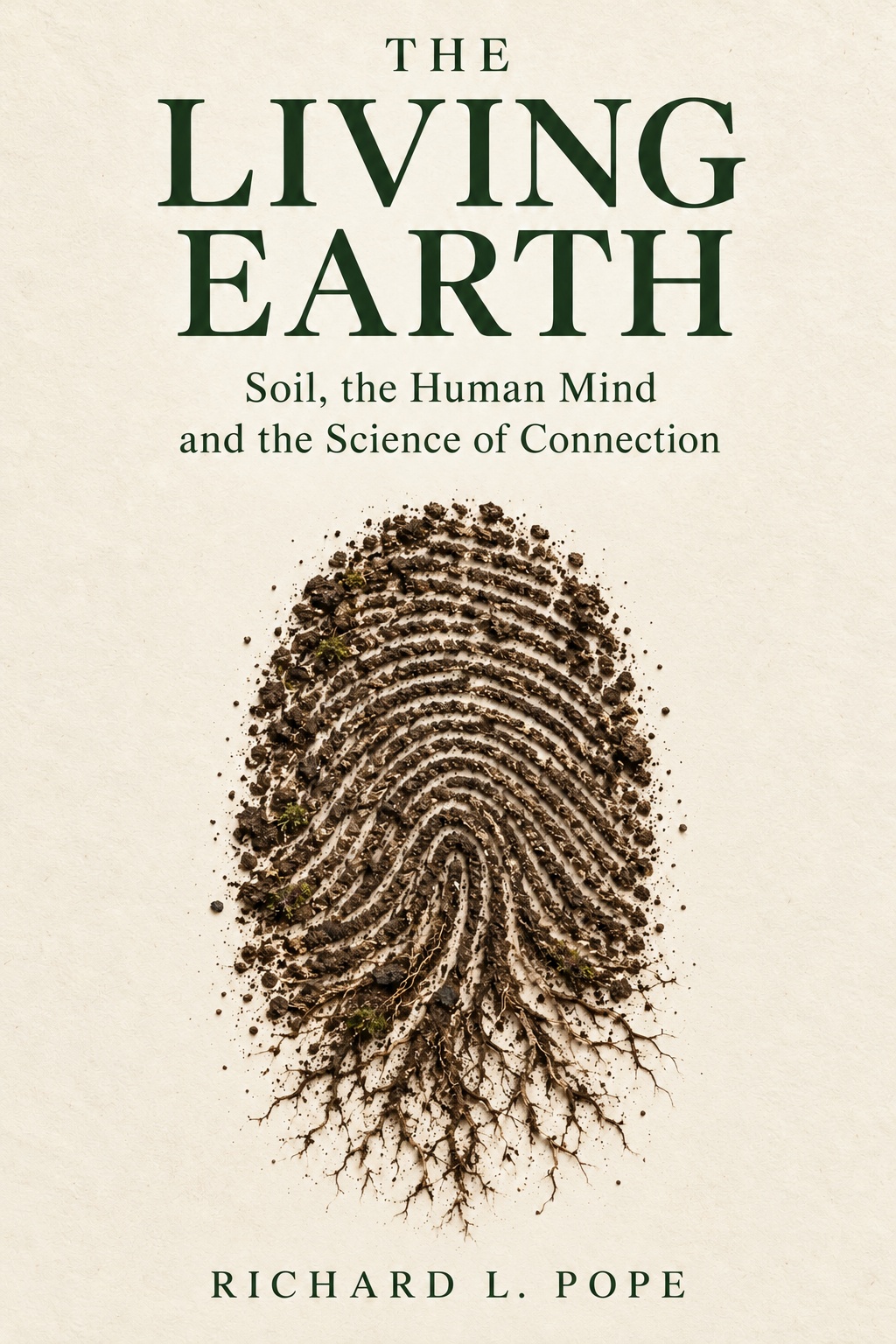
The Living Earth
Soil, the Human Mind and the Science of Connection
Prologue — A Handful of Earth · reproduced exactly as published
Prologue — A Handful of Earth
Pick up a handful of earth.
Not the dry, loose dust that gathers in forgotten corners, but the dark, damp soil of a garden or woodland. The kind that crumbles between your fingers, clings beneath your nails and carries the unmistakable scent of rain.
Feel its weight.
Let it settle into the palm of your hand.
There is something strangely familiar about this simple act. Something that seems to reach beyond the immediate sensation of cold grains pressing against warm skin.
Perhaps it reminds you of childhood. Of digging holes for no particular reason, constructing imaginary worlds from mud, or watching a worm disappear into the darkness beneath a stone.
Perhaps it recalls a parent or grandparent working in the garden, their hands stained brown, patiently tending something that would not reveal the fruits of their labour for weeks or months.
Or perhaps you feel nothing particularly profound at all.
It is, after all, just soil.
Except that it isn't.
Within that small handful exists an astonishing biological community.
Bacteria occupy the spaces between mineral particles. Fungal filaments extend through the darkness, sometimes associating with plant roots and exchanging resources. Microscopic animals feed, hunt and reproduce. Viruses interact with microbial hosts. Organic matter is broken down, transformed and redistributed.
Some organisms compete for the same resources. Others benefit from the activities of their neighbours. Some kill. Some nourish. Some alter their environment in ways that allow entirely different forms of life to thrive.
It is a world of relationships.
And most of it is invisible to us.
We walk upon it, cultivate it, build over it and occasionally complain when it finds its way into the house.
Yet without the processes taking place within soil, the landscapes we recognise would be profoundly different.
Much of the vegetation surrounding us depends upon the cycling of nutrients, the decomposition of organic matter and the physical conditions maintained by countless organisms working within the earth.
Even the most magnificent tree is not an entirely independent achievement.
Its roots encounter fungi, bacteria, minerals, water and a complicated community of living things. Its fallen leaves eventually become resources for organisms that have never encountered sunlight.
The tree alters the soil.
The soil influences the tree.
And the relationship continues.
But there is another organism holding this particular handful of earth.
You.
And that raises a question we rarely stop to consider.
What happens when the living soil meets the human body?
We know that environmental microorganisms can transfer onto human skin. Researchers have demonstrated that repeated contact with certain microbially diverse materials can alter the communities of microorganisms detected there.
Some experiments have also reported changes in markers associated with immune regulation.
These findings are intriguing.
But they do not establish that touching soil improves health, strengthens immunity or relieves psychological distress.
For there is a considerable difference between observing a biological response and demonstrating that the response benefits the person experiencing it.
And yet the question becomes more interesting the longer we examine it.
Certain soil-associated bacteria have been investigated for their effects on stress-related physiology in laboratory animals.
One such organism, Mycobacterium vaccae, has attracted particular scientific attention.
In controlled experiments, preparations of this bacterium have influenced inflammatory signalling and aspects of the biological stress response.
Some studies have also reported changes in stress-related behaviour.
That sounds remarkable.
But the experiments frequently involve deliberately administered bacterial preparations, sometimes injected into animals. They cannot tell us what happens when a person spends an afternoon planting roses.
The journey from a laboratory observation to an everyday human experience is rarely straightforward.
It is filled with questions about dose, exposure, individual biology, experimental controls and the possibility that an apparent benefit disappears when researchers attempt to reproduce it.
Science advances by confronting those questions, not by avoiding them.
But biology is only part of our story.
Return your attention to the earth resting in your hand.
Feel its texture again.
Notice how the material moves when you close your fingers. How it resists pressure, then yields. How its scent changes when disturbed.
Your nervous system is already responding.
Specialised receptors in the skin detect pressure, movement and temperature. Signals travel through nerves and are processed by the brain.
Meanwhile, your experience is influenced by something no microscope could reveal within the soil itself.
Your history.
Perhaps you remember the smell of a garden after summer rain. Perhaps you associate earth with growing food, burying something precious, or the quiet satisfaction of making something with your hands.
Memory, expectation and emotion can influence how the same physical sensation is experienced.
Two people can touch the same material and feel very different things.
One may find it comforting.
The other may find it unpleasant.
Neither response requires us to invent a mysterious property of mud.
Nor does acknowledging the importance of memory and sensation rule out biological effects from environmental microorganisms.
Several explanations can be plausible without all being correct.
And that is where our investigation begins to find its purpose.
For centuries, human beings have understood their relationship with the earth through agriculture, medicine, religion, folklore and philosophy.
We have described the soil as fertile, sacred, dirty, dangerous, nourishing and alive.
Sometimes our descriptions reflect careful observation.
Sometimes they reflect cultural meaning.
And sometimes they reveal more about human hopes and fears than about the earth itself.
Modern science offers us the means to examine some of these claims.
It can identify microorganisms, trace chemical compounds, measure immune responses and investigate the activity of the nervous system.
It can also reveal where our explanations remain incomplete.
But the more deeply we examine the living world, the harder it becomes to understand its individual components without considering their relationships.
A bacterium may behave differently in the presence of a fungus.
A fungus may respond differently when associated with a particular plant.
A plant may thrive or struggle depending upon the community surrounding its roots.
And an environment may influence human experience through several interacting routes: sensory perception, physical activity, social connection, microbial exposure or the meaning we attach to a particular place.
Not every connection is beneficial.
Not every interaction is cooperative.
And not every relationship matters equally.
Nevertheless, living systems are shaped by their encounters.
This observation provides the guiding curiosity behind the pages that follow.
It does not require us to believe that everything in nature exists for our benefit, or that the earth possesses some hidden intention to heal us.
Indeed, those assumptions could prevent us from recognising the much more interesting truth.
The living world is neither universally benevolent nor universally hostile.
It is complicated.
And we are part of that complication.
As our cities expand and our everyday environments change, new questions emerge about the biological and psychological consequences of our relationship with nature.
What do we gain from living among diverse ecosystems?
What might we lose when our exposure to them changes?
Can the microorganisms associated with soil influence human immune or nervous-system function under ordinary conditions?
Why can touching clay, tending plants or walking through woodland make some people feel calmer?
And, perhaps most importantly, how can we distinguish what the earth actually does from what we believe, remember or hope it might do?
These questions will take us from the microscopic inhabitants of soil to the workings of the human brain.
We will encounter fungi capable of shaping bacterial communities, molecules that influence immune signalling, remarkable experiments involving childhood microbial exposure, and the complicated psychological experience of belonging to a living place.
Some discoveries will strengthen our hypotheses.
Others will challenge them.
A few may require us to abandon explanations that initially seemed irresistible.
That is not a failure of the investigation.
It is its purpose.
This book follows the relationship between living soil and human experience, testing explanations against what the evidence can support.
What does the relationship between living soil and human life actually involve, and how much of that relationship have we yet to understand?
Perhaps the most surprising discoveries will come from the microorganisms themselves.
Perhaps they will come from the human senses.
Perhaps the distinction between those possibilities will prove more important than we currently appreciate.
We cannot know the answer before conducting the investigation.
But we can begin with curiosity.
And curiosity, when accompanied by evidence and the willingness to be wrong, has a remarkable habit of opening doors.
Look once more at the soil in your hand.
A moment ago, it may have seemed like an ordinary handful of earth.
Now consider the countless processes occurring within it, the relationships that have shaped its history, and the questions that arise where its world encounters yours.
Nothing about the soil has changed.
Only what you know about it.
And that, perhaps, is where discovery truly begins.
Welcome to The Living Earth.
“Hope does not require certainty that the world will heal. It requires the possibility that what we do can still make a difference.”
Source notes are collected at the back of the book. The Chapter source guide maps each chapter to the relevant studies and note groups. For ongoing evidence updates and corrections, visit https://thesporepatch.world/evidence. The Evidence companion guide explains how the online material for this book will develop.