Before the molecule had a name
The material trace, the Andean record, and living people and responsibilities — peyote and San Pedro enter through their own records.
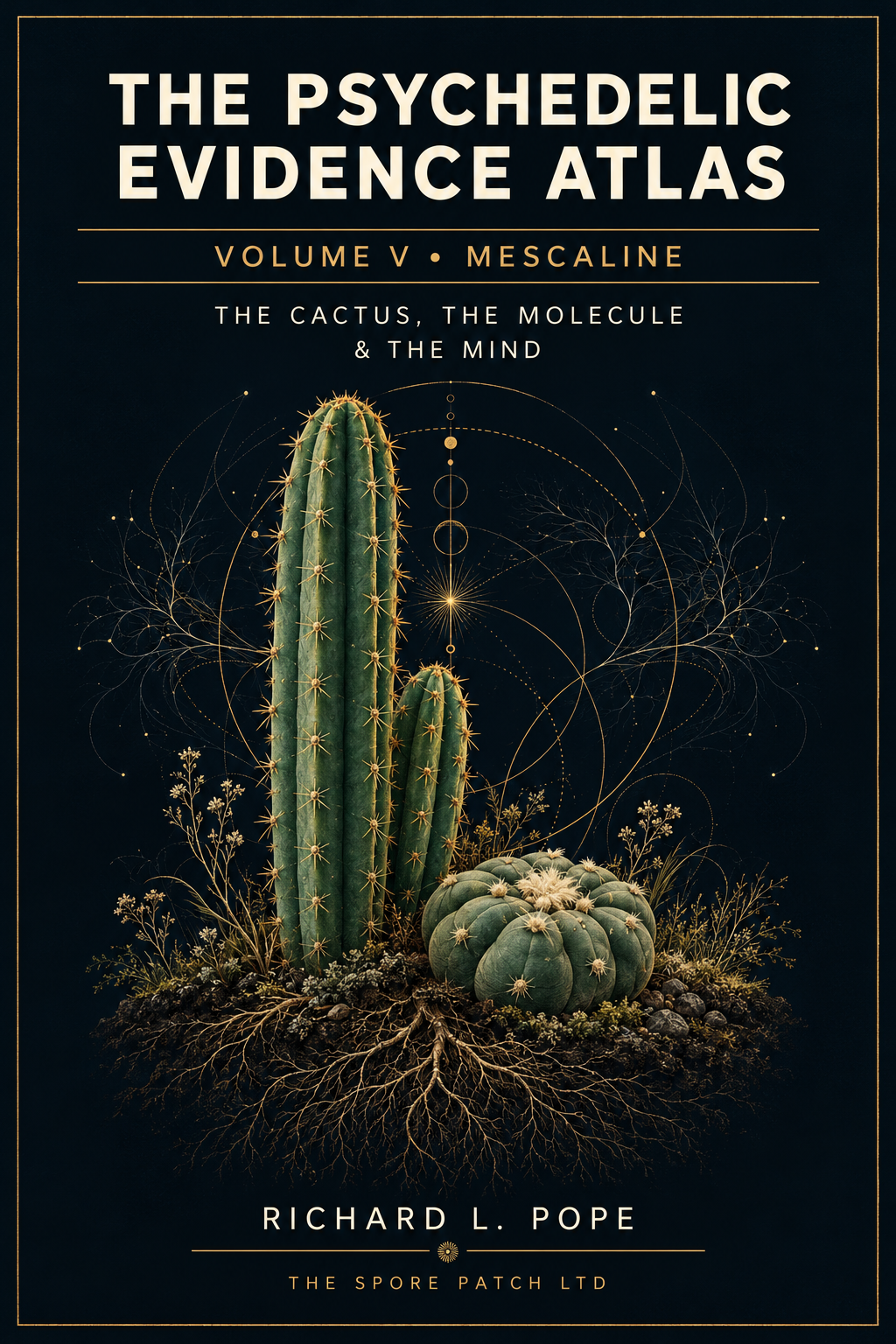
Published · Ebook edition available · The Spore Patch Ltd
Volume V · Mescaline
The fifth volume of Richard L. Pope's nine-volume audit turns to mescaline — through the distinct histories of peyote and San Pedro, early chemical investigations and modern human research. It examines altered perception, claims of benefit, documented risks, and the responsibilities surrounding conservation and Indigenous traditions.
At its heart are extended readings of Aldous Huxley and Carlos Castaneda: writers whose influence invites both personal reflection and careful questioning. The volume makes room for wonder while asking what each source can actually support.
Published as a reflowable EPUB 3 ebook, £7.99. The download link is sent by email after checkout.
Two ways to read. Every purchase includes both the EPUB download and online reading: sign in with the email you bought with and Volume V opens in your browser from your own library, which remembers where you left off.
The governing principle
A cactus, a chemical compound and a written account are not interchangeable evidential objects. Where a claim moves between containers — from plant history to chemistry, from personal narrative to measured effect — the move is stated rather than assumed.
Volume V structure
Twelve chapters, with an evidence overview, a reader's guide and chapter source notes — bringing scientific evidence into conversation with cultural history and literature.
The material trace, the Andean record, and living people and responsibilities — peyote and San Pedro enter through their own records.
Peyote — peoples, places and continuity; San Pedro — names, plants and preparations. Neither history is collapsed into the other.
The chemical investigations that made mescaline measurable, and how the compound is measured — dose, kinetics and the limits of each method.
Huxley's doorway, Carlos Castaneda's teacher and the evidence, and what language can and cannot carry of the experience itself.
Claims of benefit weighed against the studies behind them, and the documented risks read in their contexts.
Authority and conservation responsibilities, and what the evidence leaves us with at the end of the audit.
Apparatus
Superscript links lead to notes within each chapter, and bracketed references identify chapter-level selected sources, so that each claim can be traced back to the literature it rests on.
Findings apply to the preparations, populations, methods and periods described; qualifications and unresolved questions remain part of the account rather than being smoothed away.
Scientific research, cultural history and literary criticism are given space for their different contributions. Chapter length does not indicate the strength of an evidence base, and the source notes identify each strand's limits.
The author
Author of The Fungal Evidence Atlas and The Psychedelic Evidence Atlas, published by The Spore Patch Ltd. No academic affiliations, qualifications, awards or endorsements are claimed, and none should be inferred.
The Psychedelic Evidence Atlas, Volume V: Mescaline. First edition, 2026. Published by The Spore Patch Ltd as a reflowable EPUB 3 ebook. Text copyright Richard L. Pope.
Availability
This edition is a digital publication only. The Spore Patch Ltd sells digital publications and does not sell mushrooms, supplements or remedies.
This volume is an evidence audit. It is not medical, psychological or legal advice, and nothing in it encourages the obtaining, possession or use of any controlled substance.