Published · Ebook edition available · The Spore Patch Ltd
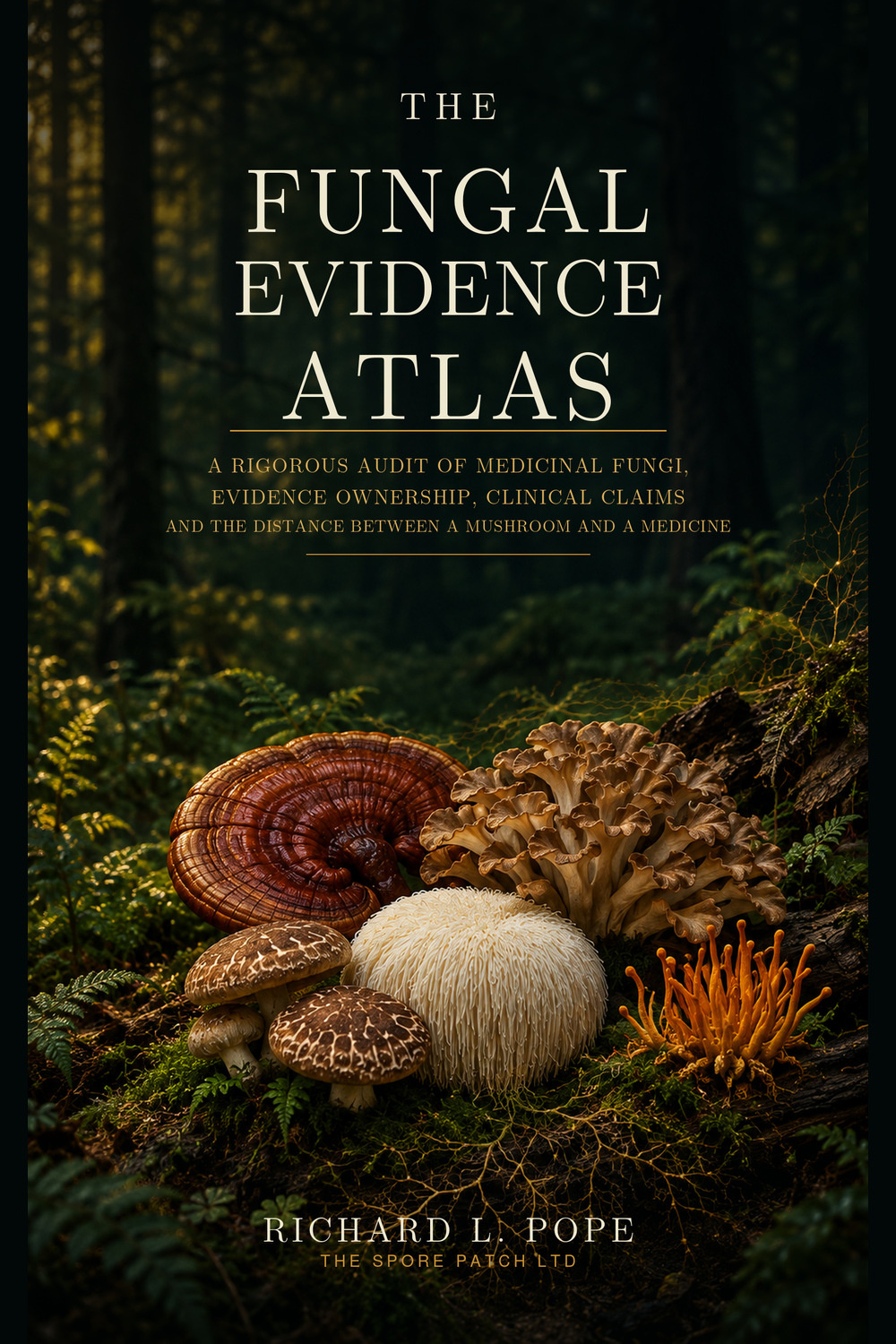
The Fungal Evidence Atlas
A rigorous audit of medicinal fungi, evidence ownership, clinical claims and the distance between a mushroom and a medicine.
- Author
- Richard L. Pope
- Publisher
- The Spore Patch Ltd
- Chapters
- 34
- Format
- Fixed-layout EPUB · £7.99
- ISBN
- No ISBN assigned for this edition
First publication edition, 2026. Fixed-layout EPUB, approximately 34 MB, produced from the 678-page publication master. The download link is delivered by email after checkout.
Two ways to read. Every purchase includes both the EPUB download and online reading: sign in with the email you bought with and the edition opens in your browser from your own library, which remembers where you left off.
The question behind the book
Does it “work” is usually the wrong question
People commonly ask whether a mushroom works. The Atlas argues that this is often the wrong question — because it hides the things that decide whether an answer means anything at all.
A single word like “Reishi” or “Shiitake” can stand for a food, a powder, an extract, a purified compound or a clinically administered preparation. These are not interchangeable, and neither is the evidence attached to them.
The scientifically useful questions
- 01What exactly was tested?
- 02In whom?
- 03Against what?
- 04For which outcome?
- 05Was it replicated?
- 06And does the resulting evidence actually belong to the mushroom named in the claim?
The governing principle
Evidence belongs first to the intervention actually tested.
Inside the Atlas
Thirty-four chapters, in seven movements
The book builds an instrument, applies it intervention by intervention, and then turns it on the literature as a whole.
- 01
Methodology and evidence reasoning
What a claim is, how a claim grows, how we know anything, how far evidence can travel, and where honest uncertainty belongs.
- 02
Individual fungal and intervention dossiers
A sequence of audits, each anchored to a defined tested intervention rather than a common mushroom name.
- 03
Comparative evidence mapping
The dossiers set against one another, so that relative strength is visible rather than asserted.
- 04
Claim distortion
How public claims drift from the results beneath them, and by which routes.
- 05
Research priorities
The experiments that would actually resolve the open questions.
- 06
The Evidence Engine
The reusable grading machinery the audit leaves behind, applicable beyond fungi.
- 07
The limits of what science can presently say
Closing arguments on what the evidence supports, and what it does not.
Contents
The full chapter list
Methodological foundation
- 01Between Medicine and Myth
- 02The Mushroom Problem
- 03How a Claim Grows
- 04How Do We Know?
- 05How Far Can Evidence Travel?
- 06How Evidence Gets Distorted
- 07Benefit, Harm and the Living World
- 08The Honest Unknown
Evidence dossiers
- 09Saccharomyces boulardii
- 10PSK / Turkey Tail
- 11Huaier
- 12Shiitake / Lentinan
- 13Schizophyllum commune / Sizofiran
- 14Reishi / Ganoderma
- 15Cordyceps-Related Preparations
- 16Lion's Mane / Hericium erinaceus
- 17Agaricus subrufescens
- 18Maitake / Grifola frondosa
- 19Oyster Mushroom / Pleurotus ostreatus
- 20Tremella / Tremella fuciformis
- 21Sanghuang / Sanghuangporus
- 22Wood Ear / Auricularia
- 23Enoki / Flammulina filiformis
- 24Poria / Fuling
- 25Chaga / Inonotus obliquus
- 26Taiwanofungus camphoratus
Comparative mapping
- 27The Comparative Evidence Map
- 28What Survived the Audit?
Research priorities
- 29The Research Worth Doing Next
Distortion analysis
- 30The Distortion Atlas
The Evidence Engine
- 31The Evidence Engine
Closing arguments
- 32What Science Can Say — and What It Cannot
- 33The Forest After the Audit
- 34The Question Beneath the Mushroom
What the Atlas examines
Organisms, and the interventions actually tested
Where the mushroom and the tested intervention differ, the Atlas keeps them apart. Evidence for a defined preparation is never assigned to the whole mushroom.
All 18 current evidence records have completed controlled verification against the verified Atlas source text. Each entry below opens the full record — proposition, evidence owner, grades, uncertainties and references — in the Evidence Library.
- E5+R5Ch. 9
Saccharomyces boulardii
Saccharomyces boulardii (live probiotic yeast)
Full record - E4-H+R4Ch. 10
PSK / Turkey Tail
Trametes versicolor (historical literature: Coriolus versicolor)
Full record - E4+R2Ch. 11
Huaier
Vanderbylia robiniophila (historical clinical taxon: Trametes robiniophila)
Full record - E4-H+R4Ch. 12
Shiitake / Lentinan
Lentinula edodes
Full record - E4-H+R3Ch. 13
Schizophyllum commune / Sizofiran
Schizophyllum commune
Full record - E2-3 ±R1Ch. 14
Reishi / Ganoderma
Ganoderma lingzhi; Ganoderma lucidum sensu stricto
Full record - Proposition-specificCh. 15
Cordyceps-related preparations
Ophiocordyceps sinensis; Cordyceps militaris; cultured medicinal fungal lineages associated with defined commercial preparations
Full record - E3±R2Ch. 16
Lion's Mane
Hericium erinaceus
Full record - E2-3 ±R1Ch. 17
Agaricus subrufescens
Agaricus subrufescens (frequently reported as 'Agaricus blazei Murrill', sometimes A. brasiliensis)
Full record - E3+R1Ch. 18
Maitake
Grifola frondosa
Full record - E3ØR2Ch. 19
Oyster Mushroom
Pleurotus ostreatus
Full record - E3+R1Ch. 20
Tremella
Tremella fuciformis
Full record - E3+Ch. 21
Sanghuang
Sanghuangporus spp., including S. sanghuang (historical identity: Phellinus linteus, with substantial taxonomic caution)
Full record - E2-3+R1-2Ch. 22
Wood Ear
Auricularia heimuer (clinical label: Auricularia auricula-judae)
Full record - E3+R1Ch. 23
Enoki / Enokitake
Flammulina filiformis (trial-reported identity: Flammulina velutipes)
Full record - Proposition-specificR1Ch. 24
Poria / Fuling
Wolfiporia hoelen (alternative generic treatment: Pachyma hoelen); historical/applied names Poria cocos, Wolfiporia cocos
Full record - E1R0-1Ch. 25
Chaga
Inonotus obliquus
Full record - Proposition-specificR1-2Ch. 26
Taiwanofungus camphoratus
Taiwanofungus camphoratus (historical names: Antrodia camphorata, A. cinnamomea)
Full record
Grades belong to the tested intervention named in each record, not to the common name shown here.
The Evidence Framework
Eight instruments, applied consistently
Each dossier in the Atlas is graded with the same set of instruments, so that records can be compared rather than merely read.
- E
Evidence maturity
E0 to E5: how far a proposition has travelled into direct human evidence.
- + / Ø / ±
Direction
Whether the best direct evidence supports, does not support, or is materially mixed.
- H
Historical flag
Marks evidence generated under older clinical conditions, preserved rather than erased.
- R
Replication
R0 to R5: how often the proposition has survived meaningful independent testing.
- CG
Claim gap
CG0 to CG4: how far the public claim has expanded beyond the direct result.
- ETV
Evidence transfer vector
Transfer across taxon, intervention, population, outcome, clinical context, replication, exposure and experimental level.
- TTC
Taxonomic transfer confidence
Whether a result can travel between species, strains and taxonomic identities.
- ITC
Intervention transfer confidence
Whether a result can travel between preparations, formulations and materials.
Editorial position
What makes this different
These are commitments about method, not claims about outcomes.
- 01
Evidence ownership is explicit.
- 02
Negative evidence remains visible.
- 03
Historical evidence is not erased merely because it is old.
- 04
Conflicting evidence is exposed rather than averaged into a convenient conclusion.
- 05
Taxonomic identity and intervention identity are treated separately.
- 06
Mechanism is distinguished from demonstrated clinical outcome.
- 07
Uncertainty is reported rather than filled with speculation.
From book to living evidence
The Evidence Library is the Atlas kept alive
The Atlas text is fixed at its edition. The Evidence Library is its living companion: the same dossiers, held as structured records that can be corrected, extended and re-graded as the literature moves.
Records are checked individually against the publication before release. Nothing is bulk-imported, and unverified extractions are never displayed publicly.
Current status
All 18 current evidence records have completed controlled verification against the verified Atlas source text and are available in full.
About the author
Richard L. Pope
Author of The Fungal Evidence Atlas and The Psychedelic Evidence Atlas, published by The Spore Patch Ltd. No academic affiliations, qualifications, awards or endorsements are claimed, and none should be inferred.
The argument is intended to carry the authority here. Every grade in the Atlas is stated with the reasoning that produced it, so it can be checked by a reader who disagrees.
Transparency
Check the work
Method, grading, sources and corrections are part of the publication, not an afterthought filed in the footer.
Methodology
How records are built, and how source material is handled.
Open →Evidence Framework
The full grading system, explained with worked examples.
Open →Sources & references
Primary references, held against each record as it is verified.
Open →Corrections & transparency
Version control, correction records and how to report an error.
Open →
Availability
Obtaining the Atlas
The Spore Patch does not sell supplements, and never will. The Atlas is published as a fixed-layout EPUB ebook, purchased outright through the shop; the download link is sent by email after checkout.
Availability
Published · Ebook edition available
This edition is a digital publication only. The Spore Patch Ltd sells digital publications and does not sell mushrooms, supplements or remedies.
- Publisher
- The Spore Patch Ltd
- Edition
- First publication edition, 2026
- Format
- Fixed-layout EPUB ebook
- Price
- £7.99
- File size
- Approximately 34 MB
- Source edition
- 678-page publication master
- ISBN
- No ISBN assigned for this edition
- Delivery
- Download link delivered by email after checkout