Psilocybin research · Volume I ·
The Architecture of Change: How Psilocybin Reorganises Neural Circuits
An evidence-led investigation of Jiang et al.’s study on activity-dependent cortical network remodelling following psilocybin exposure.
Bottom line
Selective, activity-dependent cortical connectivity changes were observed in mice. This is peer-reviewed preclinical mechanistic evidence, not demonstrated human circuit repair or therapeutic benefit.
At a glance
- Research items
- 1
- With empirical findings
- 1
- Manuscript decisions
- 2
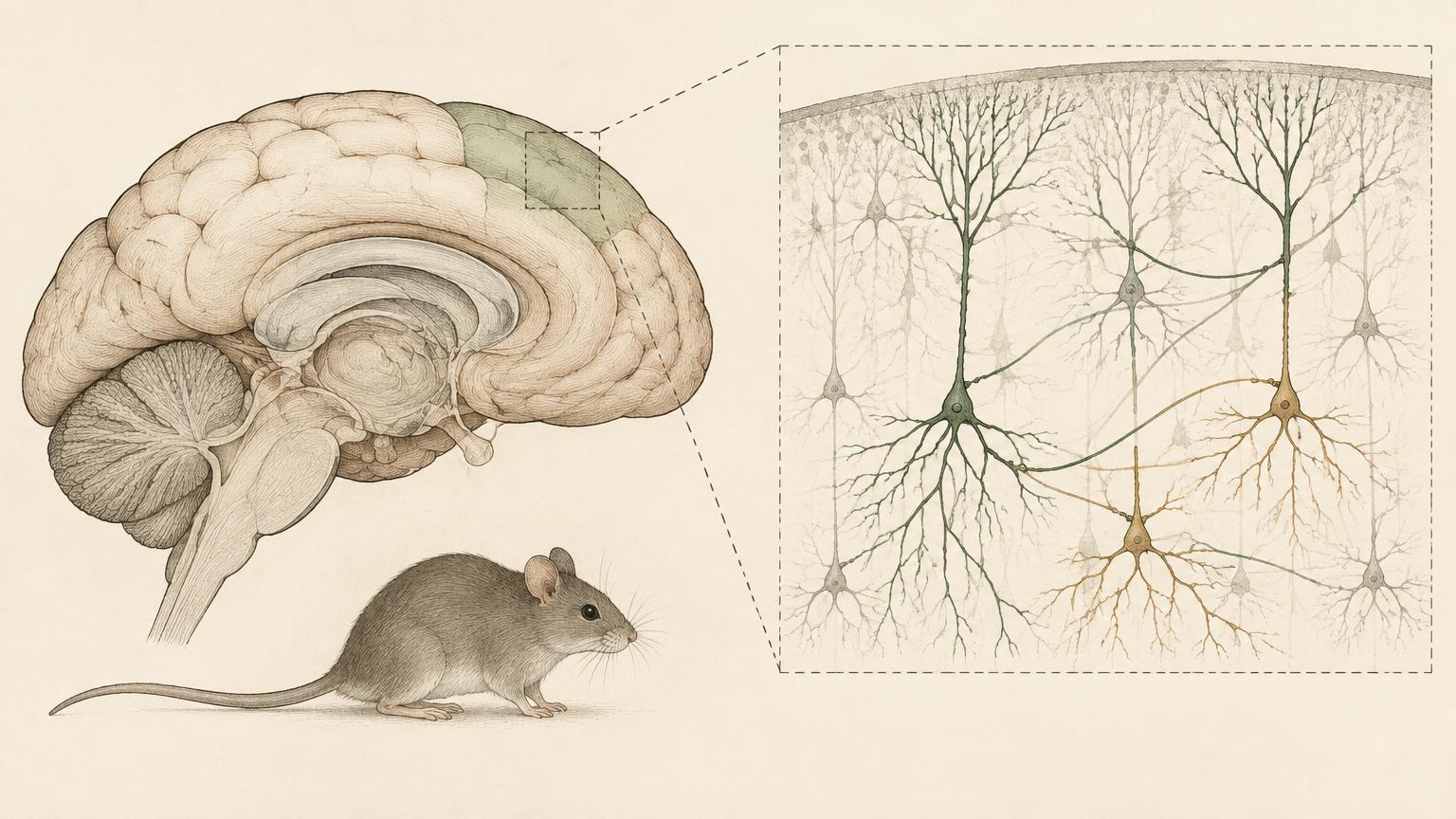
A study published in Cell has revealed new details about how psilocybin affects neural connectivity in mice.
Using monosynaptic rabies tracing, researchers examined inputs to specific populations of neurons in the frontal cortex. They found that psilocybin produced selective changes in the representation of inputs from different brain networks.
Some pathways became more strongly represented, while others became less strongly represented. Importantly, experimentally suppressing activity in a particular input region during psilocybin administration disrupted the subsequent remodelling of that pathway.
These findings suggest that psilocybin-induced plasticity is influenced by neural activity and network organisation, rather than representing uniform growth across the brain.
How the experiments worked
Mapping inputs, not reading experience
Monosynaptic rabies tracing uses a modified viral tracer to label neurons that provide direct inputs to selected starter neurons. Comparing labelled inputs across experimental groups shows how the representation of those inputs differs. It does not directly measure thoughts, therapeutic outcomes or the strength of every synapse.
Complementary imaging and recordings
Two-photon imaging examined dendritic spines, small structures that receive many excitatory inputs. Slice electrophysiology and Neuropixels recordings provided complementary measurements of neural activity. Different methods answer different questions: a change in labelled input representation is not, by itself, a measurement of psychological improvement.
Testing the role of activity
The researchers experimentally suppressed activity in a particular input region during psilocybin administration. Disruption of subsequent remodelling in that pathway supports an activity-dependent mechanism in this mouse preparation. It does not establish that choosing a particular human experience can reliably direct therapeutic rewiring.
Evidence register
- Study design
- Controlled preclinical mouse experiments.
- Principal finding
- Network-specific, activity-dependent changes in cortical connectivity.
- Strength and clinical implications
- Anatomical tracing supported by complementary imaging and experimental manipulation. Mechanistically promising but not established in humans.
- Limitations
- Animal model; tracing does not directly measure human psychological experience or therapeutic benefit. The study does not demonstrate repair of damaged human neural circuits or reliable experience-directed therapeutic rewiring.
- Evidence status
- Peer-reviewed preclinical mechanistic evidence
- Feature review date
- 27 October 2026
- Review scope
- Research feature prepared from the supplied editorial brief, with methods checked against the linked full text and citation metadata checked against the DOI record. The 27 October date is the feature review date, not the study publication date. This is a focused mechanistic appraisal, not a systematic review or a clinical grade reassessment.
- Future updates
- Monitor independent replication, method-specific validation and human studies that directly connect circuit measures to clinical outcomes. No scheduled review date or future result is implied. Any later correction or update will be recorded here; none has been added at publication.
Jiang, Q., et al. (2026). Psilocybin triggers an activity-dependent rewiring of large-scale cortical networks. Cell, 189(2), 659–675.e22.
Part of The Spore Patch’s continuing Psychedelic Evidence Atlas research programme. This page distinguishes experimental findings from clinical evidence and remains subject to revision as new research emerges.
About Volume I: Psilocybin →These bulletins are not medical, psychological or legal advice, and nothing here encourages the obtaining, possession or use of any controlled substance.